
choose your language!
 Italiano
  Deutsch
  Français
  Español
  Nederlands
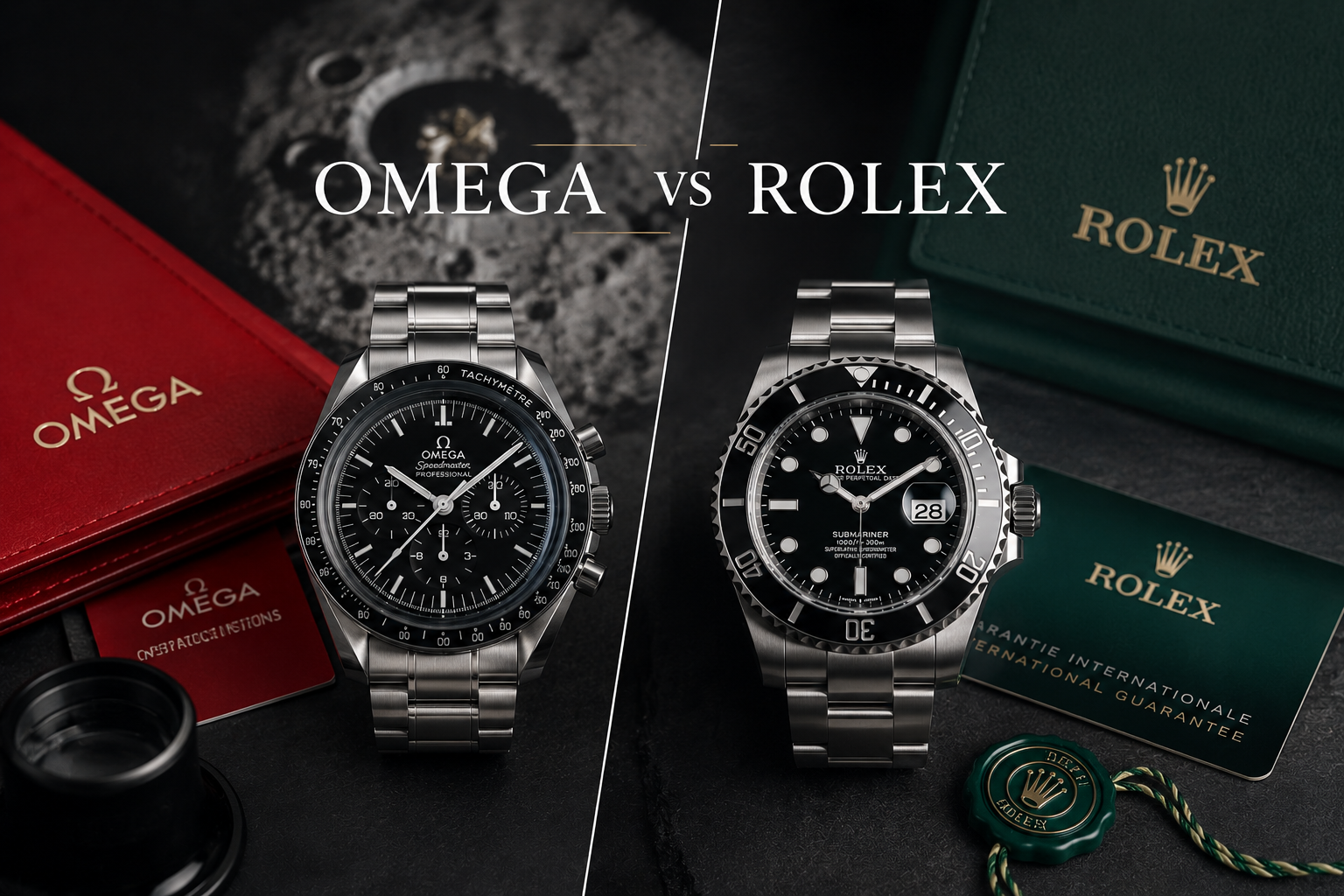
There is a question that often arises at the decisive moment, when desire transforms into purchase: Omega or Rolex, which should you choose? The short answer is that there is no absolute winner. Instead, there is the right watch for your taste, for your wrist, for your way of experiencing luxury, and also for the meaning you wish to give to this purchase.
Between Omega and Rolex, it is not just two celebrated brands being compared. Two different ways of interpreting high-end sports and prestige watchmaking are being compared. On one side, we find a maison with a strong technical identity, linked to innovation, space, diving, and certified precision. On the other, a universal symbol of recognizability, solidity, and desirability, capable of speaking to both the novice and the seasoned collector.
Omega or Rolex: Which to Choose Based on What You Seek
If your goal is to purchase an immediately iconic watch, with a very strong market presence and a universally recognized image, Rolex tends to have a clear advantage. It is the brand that, more than any other, represents the quintessential luxury watch in the collective imagination. This matters, and often matters more than one might wish to admit.
If, however, you place greater weight on technical content, variety of collections, and a positioning that combines heritage and innovation in a very concrete way, Omega deserves particular attention. It is not a fallback choice, nor a second option. It is a maison with an enormous history and models that have truly marked contemporary watchmaking.
The first useful distinction, therefore, is not between better and worse. It is between different identities. Rolex tends to express continuity, status, and value retention. Omega often appeals to those seeking a more personal relationship with their watch, less obvious but no less prestigious.
Style and Wrist Presence
Design is a real dividing line. Rolex has worked for decades on a highly consistent aesthetic language. Submariner, Datejust, GMT-Master II, Daytona, Explorer: each model evolves, but rarely breaks with its own code. This makes Rolex immediately readable and, for many, reassuring. Those who buy Rolex often know what they are buying even before wearing it.
Omega is more multifaceted. A Seamaster Diver 300M communicates contemporary sportiness. A Speedmaster Professional carries a unique historical aura. A Constellation or De Ville moves in a more elegant register. In practice, Omega offers more variations in language. This is an advantage for those who do not necessarily want the most recognizable model at first glance.
On the wrist, Rolex tends to give a feeling of compactness, balance, and design continuity. Omega, in many models, appears more technical, more detailed, sometimes more decisive in finishes and contrasts. It is not uncommon for the final choice to come down to a very simple feeling: one of the two immediately feels “yours,” the other does not.
When Rolex Convinces More
Rolex works particularly well if you are looking for a versatile watch, to be worn with ease in business, informal, and formal contexts. The strength of the brand, combined with an extremely stable design, makes many models easy to wear every day and easy to desire even in the long term.
When Omega Convinces More
Omega often emerges when the purchase stems from a more technical passion or a less predictable taste. Those who appreciate the history of the Speedmaster, the personality of the Seamaster, or the innovations of Co-Axial movements find in Omega a very solid narrative, supported by real substance.
Movement, Innovation, and Watchmaking Content
Here the comparison becomes more interesting than the simple prestige of the name on the dial suggests. Rolex has built its reputation on reliability, precision, robustness, and very high production standards. Its modern calibers are designed to guarantee continuity of performance, ease of use, and long life. It is a philosophy that aims for absolute efficiency rather than special effects.
Omega, for its part, has pushed heavily on innovation and certifications. The Co-Axial movements and Master Chronometer certification represent very strong elements for those who look at mechanics with attention. Resistance to magnetic fields, for example, is a concrete and not merely theoretical advantage in contemporary daily life.
If you view the watch as a technical object as well as a symbolic one, Omega often offers very convincing arguments. If, however, you seek a combination in which technique, reputation, and desirability converge in an almost perfect formula, Rolex remains an extremely powerful reference.
Perceived Value and Retention Over Time
On this point, it is right to be clear. Rolex, in general, enjoys extraordinary strength in the market. High demand, global recognizability, and the relative scarcity of certain references support a value retention that many customers consider central. This does not mean that every Rolex is automatically an investment. It does mean, however, that the brand maintains a unique ability to remain desired.
Omega has different dynamics. Some models have a very interesting secondary market, especially in the most iconic lines, but the average behavior is not comparable to that of Rolex. For some, this is a limitation. For others, it is an advantage, because it allows the purchase of very high watchmaking content at an often more favorable threshold.
The real point is to understand your criterion. If you want to maximize brand strength and the perceived liquidity of the asset, Rolex starts with an advantage. If you want a great name with strong history, high quality, and a relationship between price, technique, and appeal that is often more balanced, Omega has much to say.
Omega or Rolex: Which to Choose as Your First Luxury Watch
For a first entry into high-end watchmaking, Rolex is often the most instinctive choice. It has an immediate reputation, timeless models, and a rare ability not to tire. Those who wish to make an important purchase and immediately feel in the right place are rarely disappointed by a Datejust, a Submariner, or an Explorer, if the budget allows.
Omega, however, is an excellent gateway for those who want a watch with strong content and a more personal identity. A Speedmaster Professional, for example, needs no explanation to be considered a great classic. A Seamaster can be the ideal companion for those who desire sportiness, prestige, and real use.
As a first watch, therefore, the difference is less trivial than it seems. Rolex is often the most universal choice. Omega can be the more considered choice, and in many cases also the most satisfying.
Daily Use, Image, and Comfort
There is also a very concrete aspect that is underestimated: how much and how you will wear the watch. If you are looking for a timepiece to wear almost every day, with formal attire, denim, polo shirts, or jackets, both Rolex and Omega offer excellent options. However, the sensations differ.
Rolex tends to have very intuitive wearability. Cases, bracelets, and proportions are often immediate. It is one of those brands that manages to give presence without excess, except in specific cases. Omega can have a more pronounced character, with richer dials, more evident details, and a more technical identity.
Social image also matters. Some customers want a watch that is recognized and readable. Others prefer a more discreet luxury, appreciated by those who truly know how to look. In this sense, choosing between Omega and Rolex also means choosing how much you want your watch to speak for you, and to whom.
Who Really Benefits from Rolex and Who from Omega
Rolex is often the natural choice for those who place iconic status, value retention, versatility, and brand strength first. It is the brand that reassures, that communicates success with immediacy, and that tends to remain desirable over time with an almost unique continuity.
Omega particularly appeals to those who desire a historic maison with great technical credibility, a more articulated offering, and a less obvious relationship with their watch. It is a choice that often rewards those who know, compare, and want something that is not just status, but also substance.
The best purchase does not always coincide with the most sought-after brand. Sometimes it coincides with the model that best represents you when you look at it on your wrist, on Monday morning as well as Saturday evening. In a purchase of this level, emotional value weighs at least as much as the technical specifications.
If you are undecided until the last moment, the most useful criterion is this: choose Rolex if you want maximum recognizability and symbolic strength, choose Omega if you want a more personal balance between prestige, technique, and character. The right decision is not the most applauded one, but the one that will continue to seem correct even after months, when the initial enthusiasm has given way to the daily pleasure of wearing a great watch.