
choose your language!
 Italiano
  Deutsch
  Français
  Español
  Nederlands
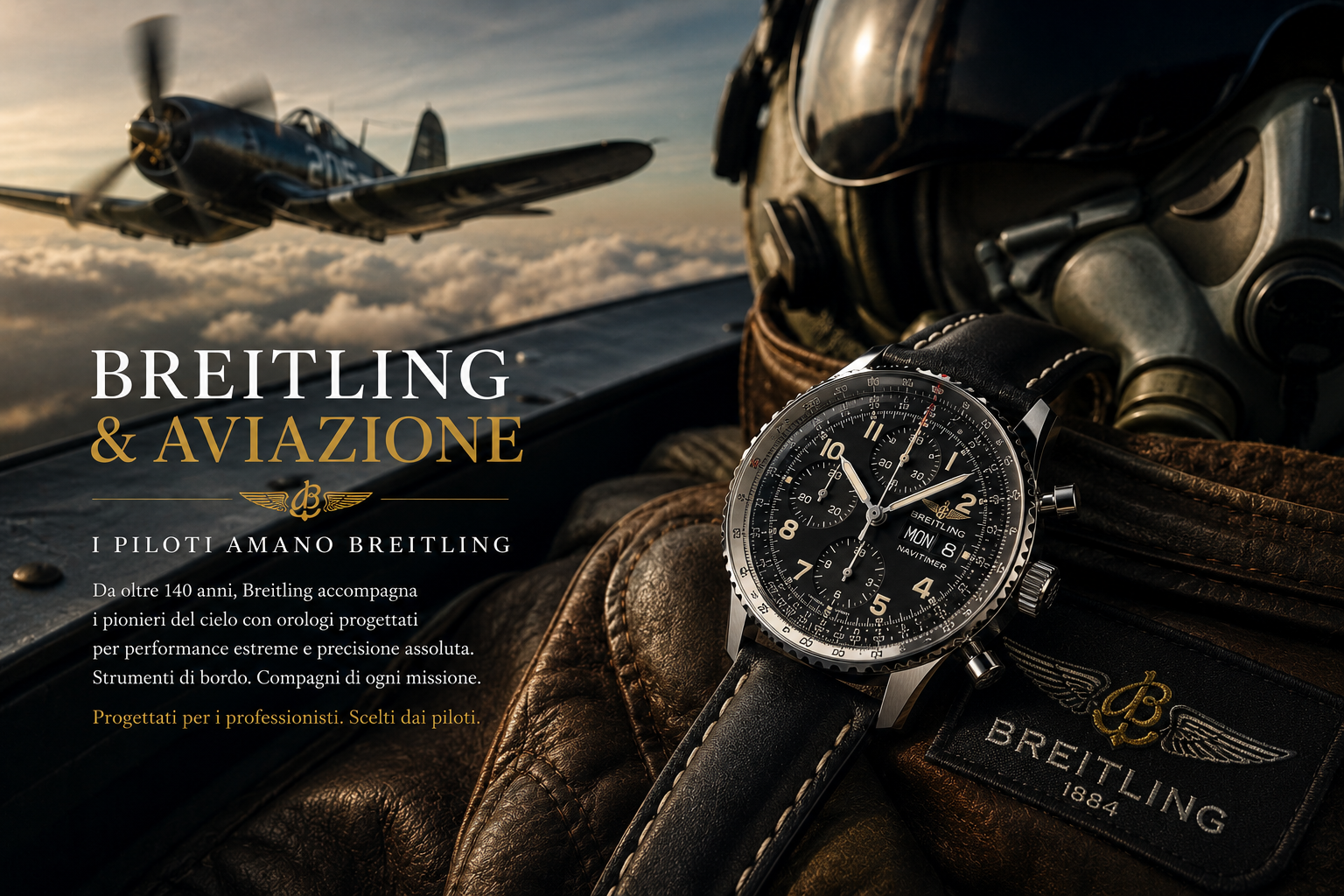
At 30,000 feet, or simply in the cockpit during an intense flight leg, a watch ceases to be an accessory and returns to being a tool. This is where it makes sense to speak of a Breitling for the professional pilot: not as a style label, but as a precise category where legibility, ergonomics, and functions matter at least as much as the prestige of the maison.
For decades, Breitling has occupied a special place in aviation-related watchmaking. This is not just due to its image, but because of a product construction that has always engaged with the aeronautical world in a concrete way. This does not mean that every Breitling is automatically ideal for an airline captain, a military pilot, or a general aviation professional. Rather, it means that the brand offers a family of timepieces with a coherent DNA, to be evaluated carefully based on the actual context of use.
Why Breitling Remains a Reference Point for Aviation
The link between Breitling and flight is not a marketing detail; it is part of its technical identity. The maison has built its reputation on solid chronographs, high-legibility dials, and instruments designed for those who must read information immediately, without hesitation.
For those who truly fly, this approach still holds value. An effective aeronautical watch must be clear at a glance, comfortable under stress, reliable over time, and proportioned to the environment in which it is worn. Tradition matters, but it is not enough on its own. A professional seeks consistency between design and function.
This is where Breitling remains convincing. It does not only offer iconic models, but lines with distinct characteristics. Some prioritize the chronograph as an operational tool, others emphasize a second time zone, and others focus on maximum legibility. The right choice depends on the type of mission, the duration of flights, interaction with other onboard instruments, and personal habit.
Breitling for the Professional Pilot: Which Features Truly Matter
When evaluating a Breitling for a professional pilot, the primary criterion should not be aesthetics, but the hierarchy of information on the dial. Sharp indices, distinguishable hands, effective contrast, and the absence of superfluous elements make a difference far more than a spectacular but unintuitive complication.
Ergonomics follow. A case that is too thick, protruding buttons, or an invasive bezel can prove uncomfortable during long hours of use. A pilot wearing headsets, gloves, or a technical uniform has different needs than someone who only uses a chronograph on the weekend. The strap also has an impact: metal bracelets, leather, or rubber vary significantly in terms of comfort, adjustment, and daily performance.
The movement is another central point. A chronometer-certified automatic offers precision and mechanical prestige but requires a more attentive relationship with the watch. A professional quartz, in certain contexts, can be a more pragmatic choice. There is no single answer for everyone; there is a balance between the pleasure of haute horlogerie and concrete functionality.
Finally, there is the question of truly useful functions. Chronographs, GMT, slide rules, dates, high magnetic resistance, or strong nighttime luminosity only make sense if they correspond to actual use. It is easy to buy “too much watch” in this segment. Choosing the right one requires more discipline.
The Breitling Collections Best Suited for the Professional Pilot
Navitimer
The Navitimer is the first name that comes to mind when thinking of the Breitling aeronautical universe. It is an icon, and for that very reason, it must be viewed with clarity. The circular slide rule and the information-rich dial have an indisputable charm, but they are not for everyone.
For the experienced pilot who appreciates tradition and desires an authentic link to the history of flight, the Navitimer remains an option of great charisma. However, its visual density requires familiarity. Those who prioritize absolute instantaneous reading might prefer less complex solutions.
In other words, it is a noble and identity-defining instrument, but not necessarily the most immediate in the range. Much depends on experience, operational habits, and one’s personal relationship with a highly recognizable technical aesthetic.
View our offers for the Navitimer collection here
https://watchdeluxe.it/product-tag/navitimer
Avenger
The Avenger line speaks a different language. Here, the focus is on presence, robustness, and a more direct approach. The cases are often generous, the functional details are marked, and the legibility is very good.
For those seeking a Breitling with a sharper professional imprint and a strong sense of solidity on the wrist, the Avenger is a collection to be seriously considered. It is less intellectual than the Navitimer and more oriented toward operational impact. This can be a concrete advantage for those who desire an immediate and authoritative instrument.
The flip side is the size. Not all wrists, and not all preferences, accommodate large cases well. For a pilot seeking presence and ease of use, it works very well. For those who prefer discretion and a slim profile, it is less ideal.
View our offers for the Avenger collection here
https://watchdeluxe.it/product-tag/avenger-2
Aerospace
The Aerospace deserves a separate discussion. It is perhaps one of the most intelligent interpretations of the avionic theme within Breitling, especially for those who evaluate functionality pragmatically. Lightness, technology, multiple functions, and a professional approach make it a very strong candidate.
For some mechanical watchmaking purists, this model may appear less romantic. But a professional does not always choose based on romance. If the goal is to have a versatile, comfortable instrument designed for real-world use, the Aerospace is often more focused than many more celebrated mechanical chronographs.
It is proof that, in the world of Breitling, technical value does not always coincide with greater mechanical complexity. Sometimes it coincides with the most rational choice.
View our offers for the Aerospace collection here
https://watchdeluxe.it/product-tag/aerospace/?v=0d149b90e739
How to Choose the Right Breitling for a Professional Pilot
The correct question is not which Breitling is the best overall, but which Breitling is best suited to your operational profile. An airline pilot flying regular routes who appreciates a second time zone may have different needs than a professional primarily seeking chronography, durability, and wrist presence.
The extra-cockpit context also matters. Many clients desire a watch that remains credible in flight but functions perfectly in a business setting. In this sense, certain Breitling references have an advantage: they maintain a strong technical identity without appearing out of place with a suit or a sports jacket.
Case size should be evaluated without being guided solely by current taste. A significant diameter can enhance the dial and improve legibility, but if the wrist cannot support it or if prolonged use becomes uncomfortable, the choice loses its meaning. In the premium segment, the most common mistake is not buying a modest watch, but buying an excellent watch that is wrong for the individual.
Budget should also be viewed strategically. Within the Breitling universe, there are significant price differences related to materials, movement, complexity, and the desirability of the reference. The point is not to spend more, but to focus the investment on the configuration that offers the best alignment between use, taste, and long-term value.
Breitling for the Professional Pilot: Prestige, Technique, Identity
Choosing a Breitling for a professional pilot means entering a specific tradition, but without sacrificing discernment. The name matters, certainly, as does the design. However, what truly makes a reference right is its ability to accompany the owner naturally, both in the cockpit and out.
Breitling continues to offer this possibility because it combines heritage, recognizability, and technical content in a credible way. Not all models speak to the same type of pilot, and that is a good thing. It means the choice can be built with precision, rather than being made through imitation.
When an aviation watch is truly well-chosen, it does not need to explain itself too much. It is noticed by those who know what to look for, but above all, it is appreciated by the wearer. And this, in the end, is the highest form of luxury: possessing a timepiece that does not just impress, but truly corresponds to your level of requirement.